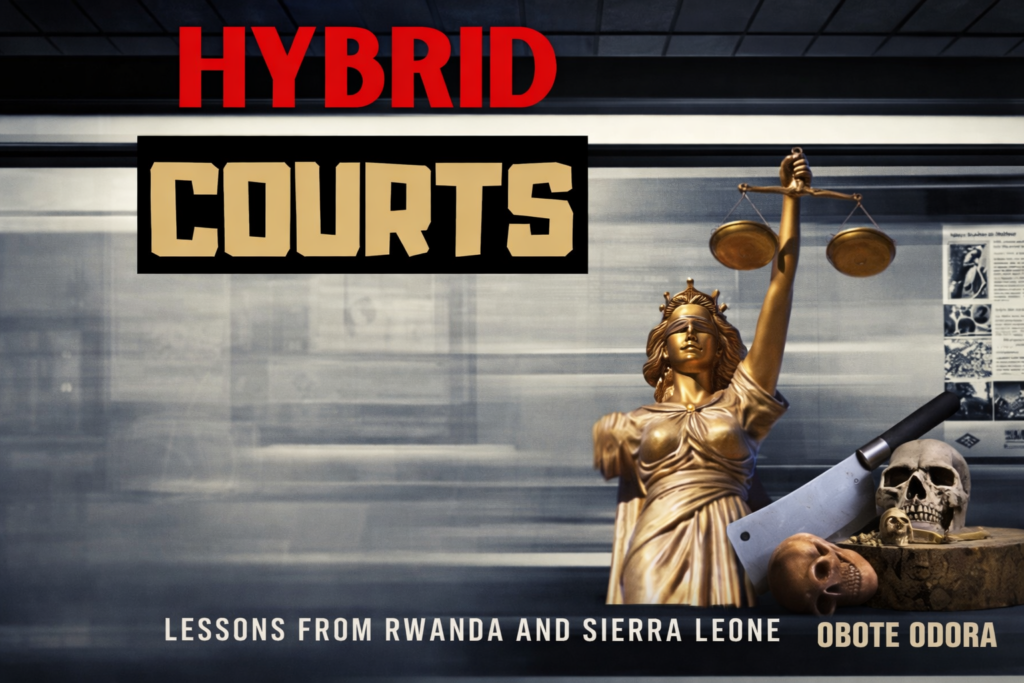
I. The Architecture of Justice: Law, Power, and the Post-Conflict World
Hybrid Courts: Lessons from Rwanda and Sierra Leone by Obote Odora is fundamentally an argument about the uneasy, often contradictory relationship among law, power, and justice in the modern international system. The book asserts, with clarity and authority, that international criminal justice cannot be understood as a neutral or purely legal enterprise; rather, it is shaped decisively by political power, institutional inequality, and historical circumstance. From its opening chapters, the work establishes that hybrid courts—particularly the International Criminal Tribunal for Rwanda (ICTR) and the Special Court for Sierra Leone (SCSL)—are not simply legal mechanisms, but responses to state failure and international inaction.
Odora situates these courts within a broader narrative of global governance, emphasizing that the post-Second World War international order, dominated by powerful states and institutions such as the United Nations Security Council, determines when and how justice is pursued. The central thesis is unmistakable: justice emerges not as an independent moral force, but as a function of power relations. The creation of tribunals following atrocities in Rwanda and the former Yugoslavia is presented not as proactive justice, but as retrospective compensation—a “diplomatic mea culpa” for earlier failures to prevent mass violence.
This framing establishes the book’s intellectual foundation. It is not merely about courts or legal doctrine; it is about the structural conditions under which justice becomes possible, delayed, or denied. By anchoring the narrative in this tension, Odora ensures that every subsequent legal discussion is tied back to a broader, compelling argument: law without power is ineffective, and power without law produces injustice.
II. Hybrid Courts as Instruments of Accountability and Limitation
At the heart of the book lies a detailed examination of hybrid courts, particularly the ICTR and SCSL, which serve as the principal institutional case studies. Odora defines hybrid courts as judicial bodies that merge elements of international and domestic legal systems, combining civil and common law traditions to address crimes committed in contexts where national systems have collapsed or are incapable of functioning effectively.
The narrative direction of the book traces how these courts emerged from the specific historical crises of Rwanda and Sierra Leone—two states marked by internal armed conflict, institutional breakdown, and widespread violations of international humanitarian law. In Rwanda, the genocide of 1994 and the subsequent establishment of the ICTR exemplify the international community’s reactive approach to justice. In Sierra Leone, the SCSL represents a negotiated model of accountability, created through cooperation between the United Nations and a sovereign state.
The principal “characters” of the book are not individuals in a literary sense, but rather legal institutions, doctrines, and structural categories that shape the administration of justice. These include the International Criminal Tribunal for Rwanda (ICTR) and the Special Court for Sierra Leone (SCSL) as judicial actors, the United Nations Security Council as the central political authority, non-state armed groups alongside state militaries as primary perpetrators, and victims and survivors as marginalized participants within the justice process. Through this conceptual framework, Odora argues that hybrid courts function under significant and unavoidable constraints.
Their operations are constrained by limited mandates, inadequate resources, evidentiary challenges, and persistent political interference. As a result, prosecutions are narrowly focused on a small group of individuals identified as bearing the “greatest responsibility,” thereby leaving the vast majority of crimes unaddressed and reinforcing the structural limitations of international justice. Yet the book argues that these limitations do not negate the importance of hybrid courts. On the contrary, they reveal their dual nature: they are both instruments of accountability and reflections of systemic inequality. This duality is central to understanding their role in international justice.
III. Legal Complexity and the Reality of Armed Conflict
A major portion of the book is devoted to explaining the legal framework governing armed conflict, particularly international humanitarian law (IHL). Odora meticulously outlines the evolution of civilian protection, the Geneva Conventions, and the Additional Protocols, emphasizing their intended purpose: to humanize war by regulating violence and protecting non-combatants.
However, the book does not present law as an abstract ideal. Instead, it demonstrates how legal principles function in practice, especially within the procedural realities of hybrid courts. Concepts such as military necessity, proportionality, and criminal responsibility are examined not only as doctrines but as tools that shape judicial outcomes. The analysis of cases like Prosecutor v. Rutaganda illustrates how courts interpret the definition of non-international armed conflict and establish the necessary nexus between crimes and hostilities.
One of the book’s most significant contributions lies in its rigorous examination of the gap between legal theory and evidentiary reality. Odora demonstrates that the prosecution of crimes committed in chaotic war environments is inherently constrained by structural and practical limitations: witness testimony is frequently inconsistent due to trauma or the passage of time; evidence is often fragmented, inaccessible, or entirely absent; and the demanding legal threshold of proof beyond a reasonable doubt remains difficult to satisfy. Consequently, acquittals must be understood not as definitive proof of innocence, but as the outcome of an evidentiary system that cannot always sustain the burden required to establish guilt within the strict framework of international law.
This insight reinforces the book’s central argument: justice is constrained not only by power but also by the inherent limitations of legal processes. Law aspires to objectivity, but in practice, it is shaped by human, institutional, and contextual factors that complicate its application.
IV. Significance and Impact: Rethinking Justice in a Unequal World
The significance of Hybrid Courts: Lessons from Rwanda and Sierra Leone lies in its capacity to reframe how international justice is understood. Odora does not merely document the functioning of hybrid courts; he demonstrates why they matter in a world defined by inequality and conflict.
First, the book establishes that hybrid courts have made enduring contributions to international jurisprudence. They have clarified legal standards, expanded the scope of prosecutable crimes, and provided precedents for future institutions, including the International Criminal Court (ICC).
Second, it reveals the systemic imbalance in global justice, where powerful states often evade accountability while weaker states are subjected to international scrutiny. This imbalance is not incidental but structural, rooted in the distribution of political, military, and economic power.
Third, the book underscores the marginalization of victims within international legal processes. Despite being the primary beneficiaries of justice, victims and survivors often lack representation and influence, becoming passive participants in proceedings that are ostensibly conducted on their behalf. Ultimately, the work argues that hybrid courts should be understood not as perfect solutions but as necessary responses to imperfect conditions. They expose the international community’s failures while simultaneously offering a framework for accountability. Their existence demonstrates that justice, though constrained, is still possible—even in the aftermath of profound human suffering.
In this sense, the book’s impact is both analytical and normative. It compels the reader to confront a difficult reality: justice in the international arena is neither neutral nor guaranteed, but it remains essential. By illuminating the interplay between law, power, and human experience, Odora provides a decisive and intellectually rigorous account of why hybrid courts matter—and why their lessons must inform the future of international criminal justice.
Hybrid Courts: Lessons from Rwanda and Sierra Leone stands as a decisive and indispensable work that confronts the realities of international justice with rare clarity and intellectual force, compelling readers to recognize that law, far from operating in isolation, is deeply conditioned by power, politics, and institutional limitation. This book must be read because it moves beyond abstract legal theory to expose how justice is actually pursued in the aftermath of mass violence—revealing the constraints of hybrid courts, the marginalization of victims, and the structural inequalities that shape accountability—while still demonstrating why such institutions remain essential in the global fight against impunity.
Its importance lies in its refusal to offer simplistic conclusions; instead, it provides a rigorous, grounded understanding of how international criminal law functions in practice and why it matters, making it foundational reading for anyone serious about understanding the protection of civilians, the prosecution of war crimes, and the enduring tension between power and justice in the modern world.
Okoth Osewe