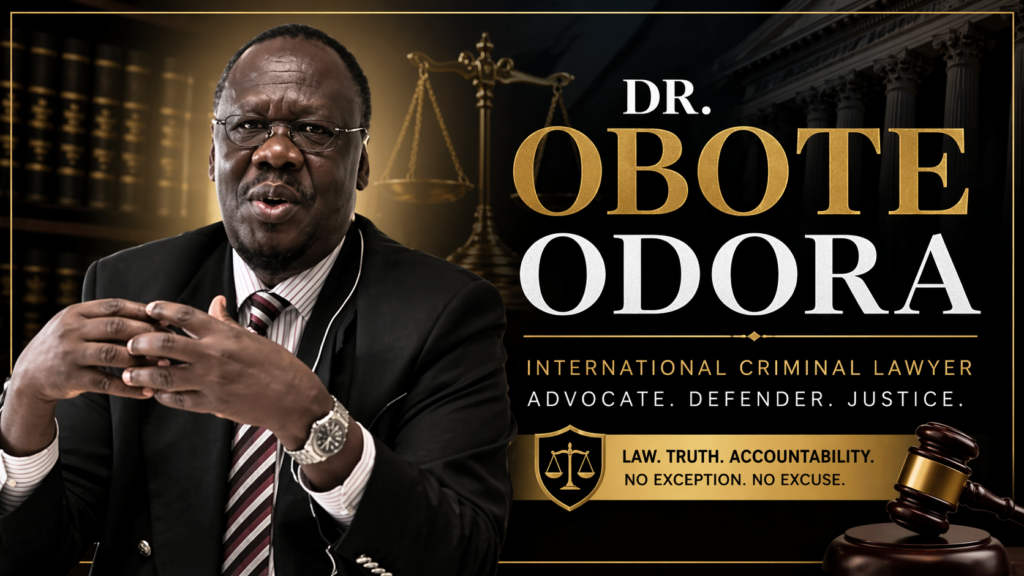
Alex Obote Odora
Alex Obote Odora is a Ugandan-born legal scholar, international criminal lawyer, academic, and author whose career spans over four decades in legal practice, international justice, scholarship, and policy advocacy. He is widely recognized for his contributions to the development of international criminal law, particularly through his work at the United Nations International Criminal Tribunal for Rwanda (ICTR), as well as for his extensive academic writings on genocide, accountability, and governance in Africa.
Early Life and Education
Alex Obote Odora was born in Uganda, where he received his early education during a period marked by significant political and social transformation. His formative years coincided with the late colonial and early post-independence eras, which shaped his later intellectual interest in governance, justice, and state institutions. He completed his primary education at Palenga Primary School and then attended Lira Muslim School and Masindi Senior Secondary School before enrolling at Nabumali High School, where he studied English, Economics, and History.
Odora pursued legal studies at Makerere University, one of Africa’s most prestigious institutions, graduating in 1974 with a Bachelor of Laws (LLB) degree. He subsequently obtained a Postgraduate Diploma in Legal Practice from the Law Development Center in Kampala, qualifying him to practice law in Uganda.
Seeking advanced legal training, Odora moved to Sweden, where he enrolled at Stockholm University. There, he earned a Master of Laws (LLM) in Public International Law in 1991, followed by a Doctor of Laws (LLD) in International Criminal Law in 1997. His doctoral thesis, “The Judging of War Criminals: Individual Criminal Responsibility under International Law,” examined foundational questions of accountability for war crimes and contributed to scholarly debates on international justice.
Legal Career and Early Professional Experience
Odora began his professional career as a Pupil State Attorney at the Directorate of Public Prosecutions in Uganda in 1975, and joined the staff of the Law Development Centre as an Assistant Lecturer in 1976 before leaving Uganda for fear of political prosecutions to Kenya in February 1977. In September 1977 Odora, for security reasons, moved to Zambia. While in Zambia, Odora worked as a State Advocate in the Directorate of Public Prosecutions in Zambia between 1977 and 1980. In this role, he prosecuted criminal cases at various levels of the judiciary, gaining substantial courtroom experience. His work required him to prosecute in both urban and rural jurisdictions, contributing to his practical understanding of criminal law across diverse contexts.
Following his tenure in Zambia, Odora returned to Uganda, where he entered private legal practice as an advocate of the High Court. He specialized in criminal law, criminal procedure, and evidence, while also engaging in civil litigation. During this period, he served in several public and advisory capacities, including as a member of government commissions of inquiry and the Uganda Government Scholarship Board.
Academic Career
Odora transitioned into academia in the 1990s, initially lecturing at Stockholm University while pursuing his doctoral studies. He taught courses in international criminal law, international humanitarian law, and human rights law, contributing to the training of both undergraduate and graduate students.
He later served as a lecturer at the University of Swaziland (now Eswatini), where he played a key role in introducing courses in international criminal law and human rights law. His teaching emphasized the intersection between legal theory and practice, preparing students to engage with contemporary legal challenges in Africa and beyond.
United Nations Career: International Criminal Tribunal for Rwanda
Odora’s most prominent professional contributions were made during his tenure at the United Nations International Criminal Tribunal for Rwanda (ICTR), where he served from 2000 to 2010. Over the course of a decade, he held several senior positions, including Legal Adviser, Head of Legal Advisory Section, Senior Legal Adviser, and Chief of Appeals and Legal Advisory Division.
At the ICTR, Odora was deeply involved in the prosecution of individuals responsible for the 1994 Rwandan genocide. His work included drafting indictments, advising the Prosecutor on legal strategy, and representing the prosecution in appeals before the tribunal’s Appeals Chamber. He played a critical role in shaping jurisprudence on genocide, crimes against humanity, and war crimes.
As Chief of the Appeals and Legal Advisory Division, Odora supervised a large team of legal professionals, managed complex appeals, and provided policy guidance. He also contributed to the development of procedural rules and participated in training programs for legal practitioners, including Rwandan lawyers.
His work at the ICTR extended beyond litigation to include administrative leadership, participation in institutional committees, and involvement in the transfer of cases to national jurisdictions under Rule 11bis. These efforts were part of broader initiatives to strengthen domestic judicial systems and promote sustainable accountability mechanisms.
Research, Publications, and Intellectual Contributions
Odora is a prolific author whose publications span academic legal scholarship, policy analysis, and socio-political commentary. His academic work addresses key issues in international criminal law, including genocide jurisprudence, sexual violence, case selection, and the relationship between law and politics.
Among his major academic works is his doctoral thesis on war crimes adjudication, as well as his book “Hybrid Courts: Lessons From Rwanda and Sierra Leone,” which examines the role of hybrid tribunals in post-conflict justice.
In addition to his legal scholarship, Odora has authored several books that explore political and historical issues in Africa. These include “Uganda: Confronting Impunity Through Accountability,” “White Man’s God, Black Man’s Burden,” and “Africa’s Decolonisation: Entrenched Imperialism.” His later works, such as “Betrayal and Dependency” and “The Militarization of Uganda,” offer critical analyses of governance, colonial legacies, and institutional challenges in Uganda.
Odora has also contributed to numerous peer-reviewed journals, book chapters, and opinion articles, engaging with topics such as international justice, human rights, and African politics. His writings often reflect a commitment to accountability, transparency, and the rule of law.
Consultancy and Later Career
Since leaving the ICTR in 2010, Odora has worked as an independent legal consultant and Executive Director of a consultancy practice specializing in international criminal law, human rights, and policy analysis. In this capacity, he has advised governments, non-governmental organizations, and international institutions.
He has also provided pro bono legal services to asylum seekers and individuals alleging violations of human rights, reflecting his ongoing commitment to justice and advocacy. His consultancy work includes legal research, policy development, and capacity-building initiatives.
Research Interests
Odora’s research interests encompass international criminal law, international humanitarian law, human rights law, and transitional justice. He has a particular focus on the African context, examining the challenges of post-conflict reconstruction, governance, and institutional reform.
Legacy and Impact
Alex Obote Odora is widely regarded as a significant figure in international criminal law. His contributions to the ICTR have had a lasting impact on the development of legal doctrines related to genocide and accountability. Through his academic and policy work, he has influenced debates on justice, governance, and human rights in Africa.
His career reflects a unique combination of practical legal experience, academic scholarship, and policy engagement. As both a practitioner and a scholar, he has helped bridge the gap between theory and practice in international law.
Conclusion
Odora’s life and work illustrate the importance of legal scholarship and practice in addressing some of the most pressing challenges of the modern world, including mass atrocities, impunity, and governance. His contributions continue to inform legal discourse and policy development, particularly in Africa and in international justice.